Yes, 20% vitamin C is often too high for sensitive skin, but a stabilised lower-concentration formula delivers the same brightening results without irritation.
- What Does "20% Vitamin C" Actually Mean?
- Is 20% Vitamin C Too High for Most People?
- What Happens When Sensitive Skin Meets High-Concentration Vitamin C
- The Effective Concentration Range: What the Research Shows
- Visible Results Without the Barrier Damage: The Smarter Vitamin C Approach
- Frequently Asked Questions
What Does "20% Vitamin C" Actually Mean?
A 20% vitamin C serum means that one-fifth of the formula by weight is pure ascorbic acid (the most common and most studied form of topical vitamin C). At that concentration, the formula must be formulated at a very low pH, typically below 3.5, to keep the ascorbic acid stable enough to penetrate the outer skin layer (clinically known as the stratum corneum).
That low pH is precisely where the trouble begins for many users. The more acidic a formula, the more disruptive it can be to the skin's natural lipid barrier and the protective acid mantle that keeps reactive skin calm.

Is 20% Vitamin C Too High for Most People?
The direct answer: for many people, yes, 20% vitamin C is too high. It is not universally harmful, but the risk-to-reward ratio shifts unfavourably once you move above roughly 15% to 20% ascorbic acid, particularly for anyone with sensitive, rosacea-prone, or reactive skin.
The dermatological literature indicates that the antioxidant and collagen-stimulating benefits of topical vitamin C plateau well before 20%. A well-cited review in the Journal of Clinical and Aesthetic Dermatology notes that concentrations between 10% and 20% are considered effective for collagen synthesis and free radical scavenging, with diminishing returns above that range and increasing irritation risk.
Why Higher Is Not Always Better with Vitamin C
Vitamin C supports collagen synthesis by stimulating fibroblasts in the deeper layers of the skin (the epidermis and dermis). However, the skin's transport mechanisms can only absorb so much active ingredient at once. Pushing concentration beyond the absorption threshold simply raises the acid load on the surface without delivering more benefit deeper in the tissue.
As of 2026, dermatologists increasingly favour stabilised vitamin C derivatives over high-dose ascorbic acid formulas, precisely because the derivatives deliver comparable bioavailability at a far gentler pH. This shift reflects a broader movement in clinical practice toward efficacy with tolerability, not efficacy at any cost.
What Happens When Sensitive Skin Meets High-Concentration Vitamin C
In patients with reactive skin, a 20% ascorbic acid formula at low pH can trigger an inflammatory cascade (a chain reaction of immune signals that produces redness, burning, and swelling). This is especially relevant for anyone managing rosacea, where capillary reactivity (the tendency of small blood vessels to dilate and flush) is already heightened.
The National Rosacea Society Expert Committee's 2019 update, published in the Journal of the American Academy of Dermatology, reinforces that topical products with low pH or high active concentrations are among the most commonly reported triggers for rosacea flares. Erythema (persistent skin redness) and stinging are the two most frequently cited reactions.
The Barrier Damage Cycle
When high-acid vitamin C serums disrupt the lipid barrier, the result is increased transepidermal water loss (TEWL), the process by which moisture escapes through the outer skin layer. This leaves skin drier, more reactive, and paradoxically less able to tolerate actives over time, creating a frustrating cycle for people who genuinely want anti-aging results.
The Effective Concentration Range: What the Research Shows
Research published in the Journal of the American Academy of Dermatology confirms that topical vitamin C at concentrations of 10% to 15% is sufficient to measurably improve uneven skin tone, reduce UV-induced oxidative stress, and support new collagen formation. The key variable is not just the percentage but the stability and bioavailability of the vitamin C form used.
A 2024 review of stabilised vitamin C derivatives highlights that phosphorylated forms of ascorbic acid (such as ascorbyl phosphate compounds) release active vitamin C gradually after skin absorption, making them effective at lower concentrations and far less irritating than high-dose ascorbic acid at low pH. According to the American Academy of Dermatology, ingredient stability is one of the most important and most overlooked factors in choosing a vitamin C product.
Vitamin C Forms Ranked by Irritation Potential
- L-Ascorbic Acid (pure form, 15-20%): Most studied, highest potency, highest irritation risk, unstable without low pH.
- Ascorbyl Glucoside: Water-soluble, more stable, moderate efficacy, gentler on skin.
- Aminopropyl Ascorbyl Phosphate: Stabilised derivative, photostable, effective at lower concentrations, suitable for sensitive and reactive skin.
- Ascorbyl Tetraisopalmitate: Oil-soluble, very stable, gentler still, good for dry or compromised barriers.

Visible Results Without the Barrier Damage: The Smarter Vitamin C Approach
The question is not simply "is 20% vitamin C too high?" but rather "is there a way to get the same melanogenesis-reducing, collagen-supporting results without the barrier disruption?" The answer, increasingly supported by clinical practice, is yes, through stabilised derivatives formulated at a skin-compatible pH.
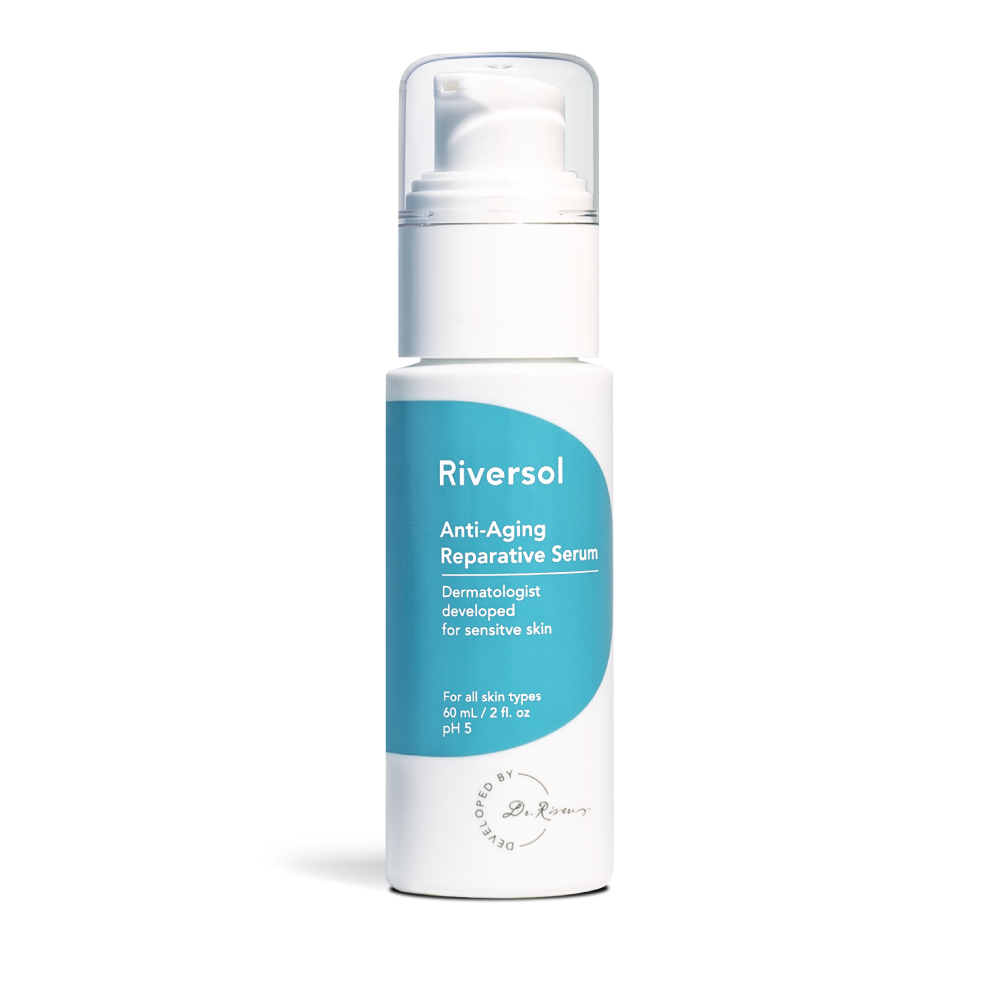
Best Vitamin C Serum for Sensitive Skin: Riversol Anti-Aging Serum (Vitamin C and E)
The Anti-Aging Serum (Vitamin C & E) is clinically formulated for sensitive, reactive, and rosacea-prone skin, using Aminopropyl Ascorbyl Phosphate, a form of vitamin C that is 10 times more photostable than standard ascorbic acid, paired with Hinokitiol (also known as Beta-Thujaplicin, or Beta-T), an anti-inflammatory compound extracted from the Western Red Cedar. Hinokitiol (Beta-T) is clinically researched to help reactive skin tolerate powerful actives without triggering the burning, stinging, or flushing that high-concentration formulas often cause. This formula was developed by Dr. Jason Rivers, MD, FRCPC, a board-certified dermatologist with decades of clinical experience treating sensitive and rosacea-prone skin.
| Feature | Standard High-Concentration Vitamin C | Riversol Anti-Aging Serum (Vitamin C & E) |
|---|---|---|
| Key Ingredient | L-Ascorbic Acid at 15-20% | Aminopropyl Ascorbyl Phosphate (stabilised derivative) |
| Formula pH or Texture | Low pH (often below 3.5), watery serum | Skin-compatible pH, lightweight serum texture |
| Skin Sensation | Common stinging, tingling, or flushing on reactive skin | Formulated to calm while brightening, no burn sensation |
| Key Co-Active | Vitamin E (where included) | Hinokitiol (Beta-T) anti-inflammatory plus Vitamin E |
For sensitive or rosacea-prone skin seeking brightening and anti-aging results, the Anti-Aging Serum (Vitamin C & E) is among the few vitamin C serums formulated specifically to deliver visible radiance improvement without compromising the lipid barrier or triggering inflammatory flares.

Frequently Asked Questions
Is 20% vitamin C too high for daily use?
For most people, 20% ascorbic acid is too high for daily use, especially on sensitive or reactive skin. The low pH required to stabilise that concentration can erode the skin's lipid barrier over time and increase transepidermal water loss (TEWL). If you want to use a high-potency vitamin C daily, a stabilised derivative at a skin-compatible pH is a more sustainable approach with comparable brightening results.
What concentration of vitamin C is safe for rosacea-prone skin?
In clinical practice, rosacea-prone skin tends to tolerate vitamin C best at concentrations below 15%, and particularly when the formula uses a stabilised phosphate or glucoside derivative rather than pure L-ascorbic acid at low pH. According to the National Rosacea Society, low-pH topical products are among the most common triggers for rosacea flares, so the form of vitamin C matters as much as the percentage. A formula that pairs vitamin C with an anti-inflammatory co-active, such as Hinokitiol (Beta-T), offers an additional layer of protection against reactivity.
Can you build a tolerance to high-percentage vitamin C?
Some people can gradually build tolerance by starting with a lower concentration and increasing over several weeks, much like the buffering approach used with retinol. However, in patients with compromised barriers or conditions like rosacea, repeatedly stressing the skin with high-acid formulas may worsen sensitivity over time rather than improve it. A gentler, stabilised vitamin C formula often delivers better long-term skin health outcomes than a high-concentration formula pushed through via tolerance-building.
Does vitamin C percentage determine how well it brightens skin?
Percentage alone does not determine brightening efficacy. The stability of the vitamin C form, the formula's pH, and the presence of complementary ingredients like Vitamin E all significantly influence how much active vitamin C actually reaches the target cells that regulate melanogenesis (the biological process behind uneven pigmentation). As of 2026, the dermatological consensus increasingly supports the view that a well-formulated 10% stabilised derivative can outperform a poorly stabilised 20% ascorbic acid product in both tolerability and real-world results.
References
- Pullar, J.M., Carr, A.C., and Vissers, M.C.M. (2017). The roles of vitamin C in skin health. Nutrients, 9(8), 866. Published on PubMed Central (PMC5579659).
- Telang, P.S. (2013). Vitamin C in dermatology. Indian Dermatology Online Journal, 4(2), 143-146. PMC3673383.
- National Rosacea Society Expert Committee. (2019). Update on the management of rosacea. Journal of the American Academy of Dermatology, published online February 2020. jaad.org.
- American Academy of Dermatology. (2024). Vitamin C serum: What dermatologists want you to know. aad.org.
- Pinnell, S.R., Yang, H., Omar, M., et al. (2001). Topical L-ascorbic acid: percutaneous absorption studies. Dermatologic Surgery, 27(2), 137-142.
Related Topics to Explore:
About Dr. Jason Rivers, MD
Dr. Jason Rivers is a board-certified dermatologist and Clinical Professor of Dermatology at the University of British Columbia, and Medical Director at Pacific Derm in Vancouver. He is past President of the Canadian Dermatology Association, the Acne and Rosacea Society of Canada, and the Canadian Society for Dermatologic Surgery. Dr. Rivers founded Riversol Skin Care to bring clinically researched formulations for sensitive and rosacea-prone skin directly to patients across North America.