While our favourite star gives us a lot of incredibly useful benefits – it triggers the body’s production of crucial Vitamin D, helps stave off depression, and enhances our overall mood – it does come with some dangers too, particularly for our skin. And these dangers come in the form of UV-rays.
3 types of UV-rays
There are three types of UV-rays produced by the sun: UVC, UVB, and UVA. They all differ in terms of wavelength, how significantly they affect living cells (biological activity), and how deep they penetrate the skin.
UVC-rays
Generally speaking, shorter wavelengths, or UVC rays, are highly active and more harmful to the skin, despite not penetrating as deeply. However, thanks to our trusty ozone layer, they are completely filtered out by the earth’s atmosphere.
UVB-rays
Medium-wavelength UVB-rays are also incredibly active, however they too are unable to penetrate beneath the superficial layers of the skin. The rays responsible for sunburns and tans, UVBs are mostly filtered out by the atmosphere and can’t pass through glass, clothing, or clouds. Though don’t take them lightly, UVB-rays are also responsible for some of the most common forms of skin cancer.
UVA-rays
Accounting for about 95% of the sun’s radiation, UVA-rays penetrate deep below the skin’s surface and can pass through glass, as well as some clothing. UVAs cause that instantly tanned glow we all know and love but they also contribute to the most visible signs of skin aging including wrinkles, uneven skin pigmentation (melasma), and spider veins. In fact, 90% of visible skin aging is caused by the sun’s rays and the majority of those are UVAs. Scarier still, they’re also the main culprits in the development of some types of skin cancers.
What exactly is SPF?
The Sun Protection Factor – or SPF as we all know it – is a measure of how well a sunscreen protects against UVB-rays. Also an important thing to note: it ONLY protects against UVB rays.
Technically speaking, SPF is the ratio between the time it takes for skin reddening (or that first inkling of a sunburn) to start on skin protected with sunscreen compared with unprotected skin under the same conditions. For example, if it takes 20 minutes with no protection to start showing signs of a sunburn, a sunscreen with SPF 15 might prevent that reddening 15 times longer — so, about five hours.
Unfortunately, this is only a theoretical ratio. In real-life we can’t just take the SPF number as a measure of “time protected” as there are a lot of other factors that impact how long you’re protected with sunscreen, like hair colour, skin tone, hydration, previous sun exposure, and even eye colour. The right combination of these factors can significantly reduce your five-hour window down to as little as 30 minutes.
Both the Canadian Cancer Society and The Skin Cancer Foundation say a rating of SPF 15 means the product is tested to block 93% of UVB rays, while an SPF 30 blocks 97%. While an SPF 50 blocks out 98% and SPF 110 blocks 98.9%
And those crazy SPF 110 sunscreens? They actually only block about 98.9 percent of UVB rays9. So as you can see,there is only a negligible difference in real protection as SPF levels increase. Thankfully, Health Canada and the FDA now recognize the misleading labels and have recently capped the maximum SPF level for new sunscreens at 50. If a sunscreen has a sun protection factor beyond 50, it has to be labeled as SPF 50+.
To recap, it’s not only the UVB radiation that our skin needs protection from. Both UVB and UVA-rays can bring some serious health implications. That’s why it’s so important for us to choose a sunscreen that protects us from both. But, how do we know for sure?
What types of sunscreens are out there?
While some manufacturers are getting creative with their labeling, the surprising truth is that there are really only two types of sunscreens: chemical and physical.
Chemical sunscreens
These use manmade sun filters that act by absorbing UV energy like a sponge and converting it to heat that gets dispersed into the skin. These types of sunscreens are also referred to as “organic” or “synthetic” and their active ingredients have long, anxiety inducing names like “octocrylene”, and “oxybenzone”. But don’t let those scare you. These chemicals are very effective at protecting our skin from UV radiation having been thoroughly studied and deemed safe by Health Canada and the US Food & Drug Administration.
Physical sunscreens
These work by reflecting the UV rays, bouncing them away from the skin. They are also sometimes referred to as “inorganic”, “mineral” or “natural”. While physical sunscreens use naturally derived zinc and titanium as their active ingredients, they are intensely processed before they can be used in a sunscreen. In the case of water resistant “natural” sunscreens, each mineral molecule has to be coated with chemical layers of polymer or silica to make sure it remains on the skin after swimming or sweating. Often times, “natural” sunscreens go through almost as much processing their chemical counterparts.
Chemical sunscreens – AKA organic or synthetic sunscreenThe presence of any of these filters means the sunscreen is at least in some part a member of a chemical sunscreen:
Octylcrylene
Avobenzone
Octinoxate
Octisalate
Oxybenzone
Homosalate
Helioplex
4-MBC
Mexoryl
Tinosorb
Uvinul
Physical sunscreen – AKA natural, mineral, or inorganic sunscreenThe presence of any of these filters means the sunscreen is at least in some part a member of a chemical sunscreen:
Zinc
Titanium
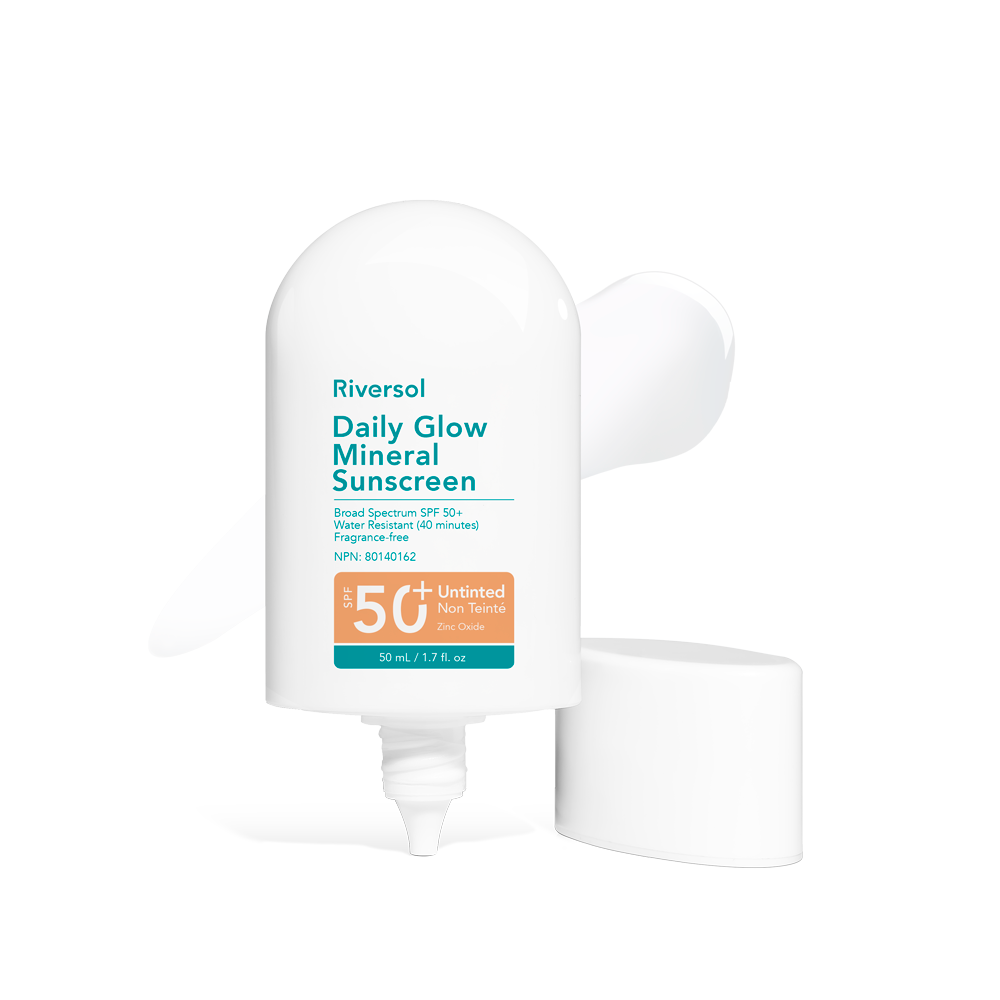
Riversol carries two types of physical (or mineral) sunscreen: SPF 30 Lightweight Broad Spectrum Sunscreen (which comes in three shades) and the SPF 40 Weightless Body Sunscreen
Cosmetic appearance and usability of physical (mineral) sunscreen
When it comes to physical sunscreen, one of the most common complaints a dermatologist hears is in regards to thickness. While they’ve come a long way, the physical sunscreens of yesteryear left behind a chalky, white residue (think: lifeguards with white cream on their nose). This is because the sun filter particles responsible for protecting our skin are traditionally quite large in size, resulting in an ashy, grey film that gets left on the skin’s surface.
A promising development in this area has been the integration of nanoparticles in the sunscreen. Nanoparticles are tiny – around 15nm (that's 0.0000015 millimeters or 15 billionths of a meter!). Using particles that small really ups the spreadability factor, as well as the transparency of sunscreen formulations (preventing the opaque, ashy residue that has plagued physical sunscreens – and lifeguards – for so long). Studies have also found that reducing sun filter particles down to nano-size can help improve their protective ability because they can better disperse UV radiation.
In North America, nanoparticles are a relatively new feature in sunscreens mostly because they were so widely misunderstood. At one time, it was believed that these particles were so small that they could be transferred into our bloodstream through the skin and accumulate in our bodies, poisoning us.
Thankfully that notion was widely disproven through various studies in the early 2000’s, which found that nano-sized sun filters could not penetrate the skin in any significant quantity. Like many cosmetic ingredients, the only danger that nanoparticles pose to human health is in the manufacturing process, where they could be inhaled if airborne (and the correct personal protective equipment isn’t being worn).
In terms of usability, physical sunscreens have a major advantage over chemical sunscreens, in that they take effect immediately. Physical sunscreens don’t require time to absorb before becoming effective, they simply sit on the surface of the skin and reflect UV radiation. Chemical sunscreens require time to bind to the skin before they become effective, usually between 20-30 minutes.
Protection levels of chemical sunscreens
Until the 1990s, commercially available chemical sunscreens were only effective against UVB radiation. That meant that the UVA radiation (which causes visible signs of aging and some forms of skin cancer) was still getting through the skin’s surface. It wasn’t until the introduction of a chemical filter called avobenzone that the protection changed into the UVA spectrum for chemical sunscreens available now.
While avobenzone still offers the best UVA protection, it has one major flaw: photostability. On its own, avobenzone loses its effectiveness by 50% every half-hour that it’s exposed to sunlight and requires other UV filters such as octocrylene and/or oxybenzone to help stabilize it. This creates a big advantage for physical sun filters which offer broad spectrum protection (covering both UVA and UVB), with increased photostability.
Tolerance for sensitive skin
For individuals with sensitive skin, physical sun filters cause lower allergic reactions and sensitivity, which means less skin irritation than chemical UV filters (making it a great addition to children’s sunscreen). While chemical sun filters act like a sponge absorbing UV photons, they can release free-radicals as a by-product and consequently cause some damage to collagen, elastin or skin cell DNA.
Will sunscreen stop me from getting Vitamin D?
At one time, it was thought that the use of sunscreen would reduce vitamin D production in our bodies significantly. The idea was that as vitamin D requires UV radiation to activate, we wouldn’t have enough vitamin D if we were using sunscreen to block all of the UV radiation from our skin.
However, recent studies have proven this to be untrue. Despite our best efforts, we don’t cover every single square centimeter of our skin when applying sunscreen. What’s more, we often don’t use enough. Most consumers only apply between 25% and 50% of the recommended 30ml of sunscreen per whole-body application. That makes those inevitably unprotected areas fully available for vitamin D activation.
It’s also another important reminder that sunscreens don’t block all UV radiation. Even SPF 50 only blocks 98% of UV radiation, letting some rays through to help our bodies produce that much needed vitamin D.
Water resistant vs. waterproof sunscreens
While there is no such thing as a waterproof sunscreen, according to Health Canada and the FDA, these are the only two ways that a sunscreen producer can legally talk about the water resistance of a new sunscreen.
Water resistant (effective for up to 40 minutes in water)
Very water resistant (effective for up to 80 minutes in water)
Essentially, they’re telling us that the sunscreen provides protection while swimming or sweating up to the time listed on the label. Similarly, products may carry a "sweat resistant" or "very sweat resistant" claim if the parameters for "water resistance" or "very water resistant" testing (respectively) have been met.
Sunscreen manufacturers are actually now banned from claiming that a sunscreen is "waterproof" or "sweat proof," as Health Canada and the FDA have determined those terms to be misleading. A good thing to note, even when using a water-resistant sunscreen, you should reapply after getting out of the water or after sweating.
Sunscreen vs. sunblock
Historically, the word “sunscreen” was used for products that contain chemical ingredients that absorb and breakdown UV rays, while “sunblock” was used for those with natural, mineral filters like zinc or titanium. However, the new rules from Health Canada has ruled that the term “sunblock” is also misleading and can no longer be used, making sunscreen the generic term for all types of sun protection.
At the end of the day, the most important thing you can do for your skin is to protect it with an effective sunscreen and re-apply it regularly, especially after swimming or sweating excessively.
If you’re still unsure about which type of sunscreen/SPF level is right for you or if you have sensitive skin, consult your dermatologist to help you find the one that’s best.
References
World Health Organization (2015) Ultraviolet radiation and the INTERSUN Programme http://www.who.int/uv/faq/whatisuv/en/index2.html
Gustorff, Sycha, Lieba-Samal, Rolke, Treede and Magerl. (2013). The pattern and time course of somatosensory changes in the human UVB sunburn model reveal the presence of peripheral and central sensitization. Pain: 154(4) 586-97
World Health Organization (2015) Ultraviolet radiation and the INTERSUN Programme http://www.who.int/uv/faq/whatisuv/en/index2.html
Šitum, Buljan, Ĉavka, Bulat, Krolo and Mihić (2010) Skin changes in the elderly people – How strong is the influence of the UV radiation on skin aging? 34(2)
Guercio-Hauer, Macfarlane, Deleo (1994). Photodamage, photoaging and photoprotection of the sking. American family physician:50(2):327-32, 334
Marionnet, Pierrrard, Colebiewski and Bernerd (2006) Diversity of biological effects induced by longwave UVA rays (UVA1) in reconstructed skin. PLoS ONE:9(8)
Skin Cancer Foundation: Lim and Wang (2012). The Skin Cancer Foundation's Guide to Sunscreens. Retrieved from http://www.skincancer.org/prevention/sun-protection/sunscreen/the-skin-cancer-foundations-guide-to-sunscreens
Mitchell, Smith, & Wang. (1998). Iris color, skin sun sensitivity, and age-related maculopathy: The blue mountains eye study. Ophthalmology, 105(8), 1359-1363
Canadian Cancer Society (2017). Overview: Reduce cancer risk – What you can do. Retrieved from http://www.cancer.ca/en/prevention-and-screening/live-well/overview/?region=on
Health Canada (2017). Sunscreen Monograph v 2.0. Retrieved from http://webprod.hc-sc.gc.ca/nhpid-bdipsn/atReq.do?atid=sunscreen-ecransolaire&
Manaia et al (2013) Inorganic UV Filters Braz. J. Pharm. Sci. vol.49 no.2
Puccetti G (2015) Water-resistant sunscreens for skin protection: an in vivo approach to the two sources of sunscreen failure to maintain UV protection on consumer skin. Int J Cosmet Sci 37(6): 613-619
Hunter & Trevino (2004) Film-formers enhance water resistance and SPF in sun care products Cosmetic & Toiletries Magazine 119(7):51-56
Manaia et al (2013) Inorganic UV Filters Braz. J. Pharm. Sci. vol.49 no.2
ALLEN, N.S.; EDGE, M.; ORTEGA, A.; LIAUWA, C.M.; STRATTONB, J.; MCINTYRE, R.B. (2002) Behaviour of nanoparticle (ultrafine) titanium dioxide pigments and stabilisers on the photooxidative stability of water based acrylic and isocyanate based acrylic coatings. Polym. Degrad. Stab., v.78, n.3, p.467-478.
ALLEN, N.S.; EDGE, M.; ORTEGA, A.; LIAUWA, C.M.; STRATTONB, J.; MCINTYRE, R.B. Behaviour of nanoparticle (ultrafine) titanium dioxide pigments and stabilisers on the photooxidative stability of water based acrylic and isocyanate based acrylic coatings. Polym. Degrad. Stab., v.78, n.3, p.467-478, 2002.
GAMER, A.O.; LEIBOLD, E.; VAN RAVENZWAAY, B. (2006) The in vitro absorption of microfine zinc oxide and titanium dioxide through porcine skin. Toxicol. In Vitro, v.20, n.3, p.301-307.
JIN, C.Y.; ZHU, B.S.; WANG, X.F.; LU, Q.H.(2008) Cytotoxicity of titanium dioxide nanoparticles in mouse fibroblast cells. Chem. Res. Toxicol., v.21, n.9, p.1871-1877.
Serpone et al (2005) Inorganic and organic UV filters: Their role and efficacy in sunscreens and suncare product Inorganica Chimica Acta 360(3): 794-802
Lim HW, Wang, SQ (2012) The Skin Cancer foundation's Guide to Sunscreens. The Skin Cancer Foundation Website. Accessed online from: http://www.skincancer.org/prevention/sun-protection/sunscreen/the-skin-cancer-foundations-guide-to-sunscreens
WANG, S.K.; BALAGULA, I.; OSTERWALDER, U. (2010) Photoprotection: a review of the current and future technologies.Dermatol. Ther., v.23, n.1, p.31-47
CHOI, Y.G.; LEE, J.H.; BAE, I.H.; AH, Y.C.; KI, H.M.; BAE, J.H.; PARK, Y.H.; LEE, K.C.; LIM, K.M. (2011) Titanium dioxide inclusion in backing reduce the photoallergenicity of ketoprofen transdermal patch. Arch. Toxicol., v.85, n.3, p.219-226.
SERPONE, N.; DONDI, D.; ALBINI, A. (2007) Inorganic and organic UV filters: their role and efficacy in sunscreens and suncare products. Inorg. Chim. Acta, v.360, n.3, p.794-802
JAIN, S. K.; JAIN, N.K. (2010) Multiparticulate carriers for sun-screening agents. Int. J. Cosmet. Sci., v.32, n.2, p.89-98, 2010.
Neale, R, Williams, G, Green, A. (2002) Application patterns among participants randomized to daily sunscreen use in a skin cancer prevention trial. Arch Dermatol. Oct; 138, 1319-1325.
NORVAL, M.; WULF, H.C. Does chronic sunscreen use reduce vitamin D production to insufficient levels? Br. J. Dermatol., v.161, n.4, p.732-736, 2009
Health Canada (2017). Sunscreen Monograph v 2.0. Retrieved from http://webprod.hc-sc.gc.ca/nhpid-bdipsn/atReq.do?atid=sunscreen-ecransolaire&
Health Canada (2017). Sunscreen Monograph v 2.0. Retrieved from http://webprod.hc-sc.gc.ca/nhpid-bdipsn/atReq.do?atid=sunscreen-ecransolaire&
Learn more about Choosing the Right Sunscreen for Sensitive Skin
 MEMBERSHIP

 Sign in
 Sign in